The heating and cooling processes of hot-melt glass are affected by glass material and production origin, so parameters of the digital temperature controller shall be adjusted accordingly. Take the firing of hot-melt corrugated glass as an example: for domestic high-quality float white glass, the firing temperature is approximately 780℃; for F-green glass, it is about 770℃; for golden glass, around 750℃; and for ultra-clear glass, approximately 785℃.
There are also objective factors affecting the final temperature reading:
- Stability of local power supply: voltage fluctuations will affect the measurement accuracy of the temperature controller;
- Thickness of glass: the firing temperature difference caused by different glass thickness is about 5℃–8℃.
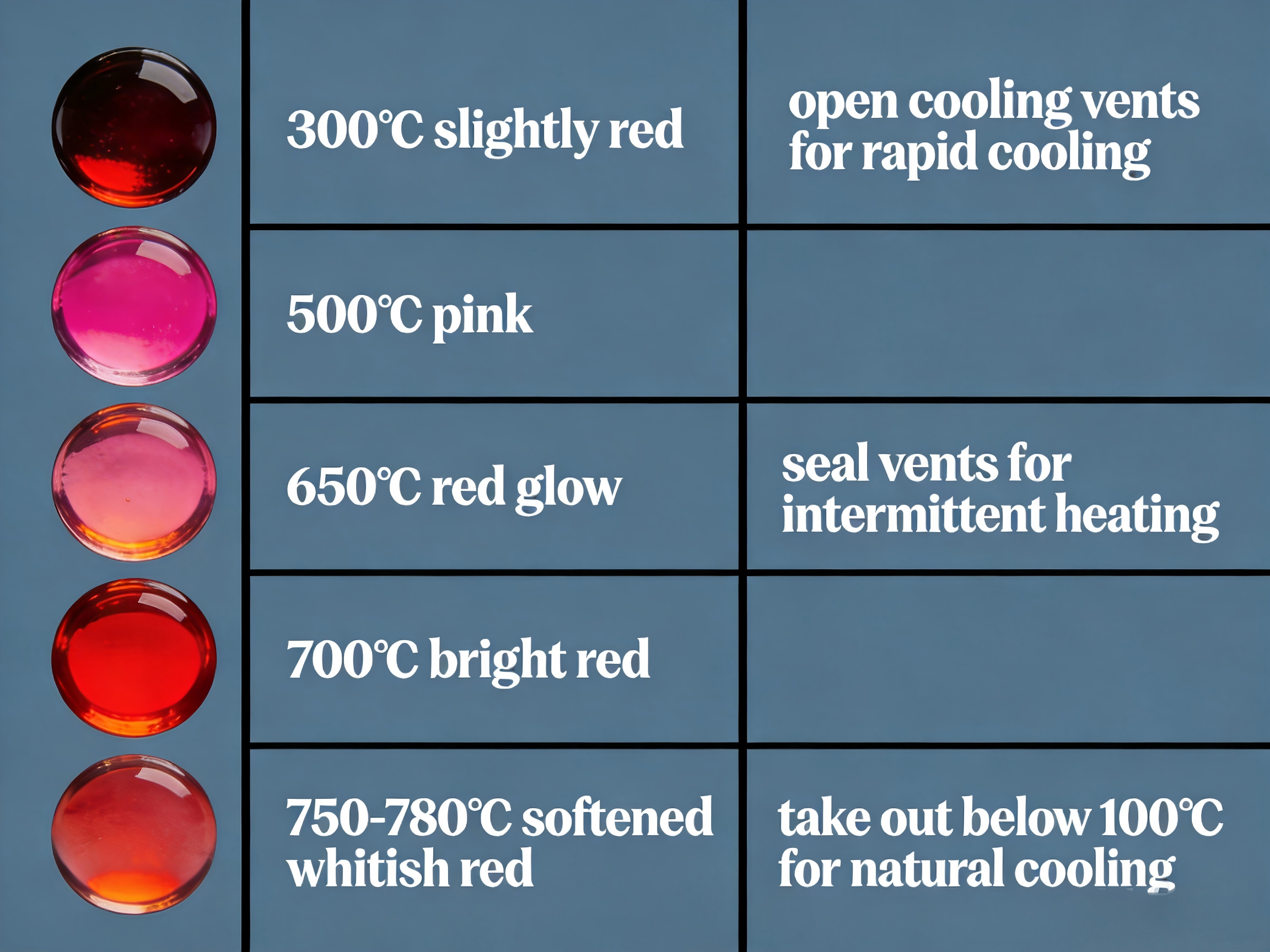
If the power supply is unstable, the firing status can be judged through the observation port: according to empirical data, when the temperature rises to around 300℃, the glass turns slightly red to the naked eye; at about 500℃, it shows pink; at around 650℃, it starts to emit red light, and turns bright red at about 700℃, when obvious heat can be felt near the observation port. When the glass turns whitish bright red at 750℃–780℃, it indicates that the glass is fully softened and ready for annealing.
To avoid spontaneous cracking of products during annealing, all cooling vents on the facade and both sides shall be opened for rapid cooling.
When the temperature drops to around 300℃ within 1 hour, seal all cooling vents and reheat the glass intermittently. Repeat the process several times, then the glass can be taken out of the furnace for natural cooling when the temperature is below 100℃.
The hot-melt glass produced by this process has smooth, rounded joints with strong concave-convex texture and high transparency. It shows brilliant refraction effect under light or strong sunlight, with excellent decorative performance.
Post time: Mar-04-2026